This week has gone by so fast! It's one of those situations were it feels like you've been doing the same thing for a lifetime, yet, just yesterday you were doing something else. It seems like a forever ago that I was studying for my second round of finals of my veterinary school career. In reality, it was only two weeks ago that I was celebrating the end of the semester. I decided to take the first week of the summer to go home and visit with family. I will spend the majority of the next eleven weeks here.
I moved down to Lexington last Sunday afternoon and took the day to get myself settled. Monday morning, I met with the technician manager at Rood and Riddle Equine Hospital. She took me to get a badge made and gave me a couple official R&R polos. Then, she took me to surgery and left me to observe there for the remainder of the day. I wasn't able to do a whole lot since I was only going to be there for one day. I was able to observe the prepping and recovery of several horses as they went in and out of surgery. That particular day seemed to have a lot of joint reconstructions to me. I watched several arthroscopies and an umbilical hernia repair surgery. That was the cleanest day I have had thus far.
Tuesday, I met Dr. Friend at 6:45 a.m. in a Lowe's parking lot. It seems like a strange setup, but it really makes sense because he lives on the opposite side of Lexington from the clinic and most of the farms he deals with are over that way as well. It just wouldn't make sense for him to have to drive all the way over to this side just to pick me up and drop me off. There has been a veterinary applicant with us this week, Lindsey. I spent most of the day watching what she was doing to help Dr. Friend be as efficient as possible at each appointment. After the first couple, I was helping set up the cart with all the Therio stuff (ultrasound, tote, scrub bucket, and lavage fluids) and holding the tails out of the way. I discovered very quickly that 55 degrees feels much colder on a windy and rainy day. I couldn't stay warm for the life of me. I was thrilled to be learning even the smallest things.
Wednesday, I discovered that Dr. Friend has a very independent intern, Dr. Jordan Kiviniemi-Moore, and a technician, Kim. I traded places with Kim and rode with Jordan. She is very fun to work with. Her farms tend to be a little bit smaller and low-key. I still couldn't stay warm. Our day was very similar to Tuesday. We did a lot of pregnancy checking and cycle monitoring. She allowed me to look through a speculum to see a mare's cervix before she took a sample for culture and cytology. I enjoyed being able to see what she was talking about. By this time I realized that my predecessor had not been joking when she said I would want to bring my own food to avoid starvation. Tuesday, the only non-farm stop we made was at a gas station to fuel up. Wednesday, we stopped at a Starbucks (They were out of the majority of their breakfast sandwiches.) and at R&R to restock the truck and do the billing for the day.
I took Thursday off to do a little adulting. I had arranged to have internet hooked up in the house I'm being housed in with Craig. I also had a few other errands I needed to do. Unfortunately, the internet company canceled on me. It turned out to be a very aggravating day. The bright side was that it was the first sunny and warm day I had seen in Kentucky.
Friday, we all started together at the first farm. Dr. Friend taught me how to properly scrub a ulva for sterile prep. He also instructed me on how to glove up and feel her cervix to do a lavage. After that, I rode with Jordan again. It started out pretty normal with a lot of therio work. Later in the day, we got an emergency call for a down foal. We discovered, after a while that it most likely has a botulism infection. We think we may have been able to get the anti-serum in soon enough to save it.
Today was another busy day with therio checks and other calls. I was able to do IV injections, blood draws, and an IM injection today. I really enjoyed being able to do things while Jordan was making notes or getting ready for the next procedure. The last stop of the day, we inseminated a mare. I hope she takes!
Every day has been an early start and a long haul without much of a break. I love doing it through! Tomorrow will be another early morning, but it's supposed to only be a half day. I'm sure next week will be just as fun as this week. I'm sorry I didn't have any pictures this week. I'll work on that for next week.
Saturday, May 21, 2016

Monday, August 17, 2015
RREH Surgery the final 2 weeks!!!
Hello Everyone! I am starting out with saying that my experience at Rood and Riddle Equine Hospital was one of the GREATEST experiences of my life! The people are what really make this hospital an amazing place to be!!! I have learned so much from every single person here and I would not have traded my summer experience for any other hospital!!!! With that being said my last 2 weeks were jammed pack with fun surgeries and ambulatory experiences. To anyone considering RREH surgery next summer, you will gain horse handling skills you didn't even realize you needed!!! You work with predominantly young racehorses and it is a skill to handle them safely for both the people and the horses involved!! You will also be responsible for dropping horses, hoisting them, and placing them on the table correctly for various surgeries. You will learn how to clip, scrub, and sterile prep various surgical sites and then you will act as the technician in the surgery room helping the surgeon in any way that is needed. You will help the horses to recovery and then set up the room for the next surgery. If you are interested in surgery this is the experience for you because you will see some of the coolest surgeries around every day! Some other things I was lucky enough to learn was how to place arterial lines while the horse was under general anesthesia, place catheters, give pre-op drugs, give iv and im injections, draw blood, change bandages, flush mares, and castrate horses. If you are interested in learning anything equine, I recommend applying for RREH!
My last two weeks there were some interesting colic surgeries!


Pictured above is a horse suffering from multiple strangulating lipomas and unfortunately extensive necrosis to the small intestine. The first picture shows one of the many lipomas.
 Closing the orbit
 Eye after it had been removed

The next 3 pictures above are of a broodmare that suffered from a viral infection for many years in her eye. The virus was managed for many years in the infected eye until the damage was so extensive the decision was made by Dr. Latimer to perform an enucleation on the mare. An enucleation is when there is a surgical removal of the globe, conjunctiva, and nictating membrane. Before removing the eye she performed nerve blocks on the mare. Different blocks you can perform before an enucleation are an AP block (palpated dorsal to zygomatic arch), frontal block, retrobulbar block, and an infratrochlear block. This procedure is sometimes done on a sedated standing horse, but for this mare she was placed under general anesthesia. Then 2 incisions were made (one above the eye and one below the eye) and the procedure was performed. Due to the vascular nature of the orbit, it was essential to pack the orbit with gauze for at least 5 minutes. Then Dr. Latimer closed the orbit and placed a bandage on the mare (pictured above).
 Pictured above is a horse placed under general anesthesia to have a tieback performed. This horse was first run through the new CT machine at RREH to get a better picture of airway before surgery. The CT machine uses computer-processed combinations of many radiographs taken
from different angles to produce cross-sectional tomographic slices of specific
areas of a scanned area on the horse. It can produce a virtual 3-D image and
basically allow the doctors the opportunity to see a specific area on the body
without cutting the horse open. It will be interesting how CT images advance in equine medicine and allow new insights into disease processes.
Pictured above is a horse placed under general anesthesia to have a tieback performed. This horse was first run through the new CT machine at RREH to get a better picture of airway before surgery. The CT machine uses computer-processed combinations of many radiographs taken
from different angles to produce cross-sectional tomographic slices of specific
areas of a scanned area on the horse. It can produce a virtual 3-D image and
basically allow the doctors the opportunity to see a specific area on the body
without cutting the horse open. It will be interesting how CT images advance in equine medicine and allow new insights into disease processes.

 Above are a few pictures of Hats Off Day sponsored by Rood and Riddle!
 Super cute draft horse yearling who was being treated for canker in all 4 of his feet and he didn't feel like going back to surgery!

Triple Crown Winner!
 I even had time to work my horse and he loved Kentucky!

It was a great summer and I want to extend my sincerest thanks to Dr. Embertson, Nicole Bone, and Alanna Mathes for allowing me to come to this awesome place! To Dr. Woodie, Dr. Hopper,
Dr. Bramlage, Dr. Ruggles, Dr. Latimer, Dr. Bras, and Dr. Friend, thank you for teaching me and letting me help out! To Dr. Schott for working so hard for all of the fellows and setting up this program! I truly believe we are so lucky to have this available to all of the MSU veterinary students! To Stephanie Welsh for letting me be your shadow and training me! You are the best mother duck!!!!! To the interns you are all amazing doctors and thank you for putting up with me at night and your early mornings especially! Finally, last but not least thank you to entire staff at RREH. I learned so much from each and every one of you and I can't thank you all enough!!!!!
That is all from me, hope everyone enjoyed reading and I encourage everyone to apply next year!
My last two weeks there were some interesting colic surgeries!


Pictured above is a horse suffering from multiple strangulating lipomas and unfortunately extensive necrosis to the small intestine. The first picture shows one of the many lipomas.


The next 3 pictures above are of a broodmare that suffered from a viral infection for many years in her eye. The virus was managed for many years in the infected eye until the damage was so extensive the decision was made by Dr. Latimer to perform an enucleation on the mare. An enucleation is when there is a surgical removal of the globe, conjunctiva, and nictating membrane. Before removing the eye she performed nerve blocks on the mare. Different blocks you can perform before an enucleation are an AP block (palpated dorsal to zygomatic arch), frontal block, retrobulbar block, and an infratrochlear block. This procedure is sometimes done on a sedated standing horse, but for this mare she was placed under general anesthesia. Then 2 incisions were made (one above the eye and one below the eye) and the procedure was performed. Due to the vascular nature of the orbit, it was essential to pack the orbit with gauze for at least 5 minutes. Then Dr. Latimer closed the orbit and placed a bandage on the mare (pictured above).


Triple Crown Winner!


It was a great summer and I want to extend my sincerest thanks to Dr. Embertson, Nicole Bone, and Alanna Mathes for allowing me to come to this awesome place! To Dr. Woodie, Dr. Hopper,
Dr. Bramlage, Dr. Ruggles, Dr. Latimer, Dr. Bras, and Dr. Friend, thank you for teaching me and letting me help out! To Dr. Schott for working so hard for all of the fellows and setting up this program! I truly believe we are so lucky to have this available to all of the MSU veterinary students! To Stephanie Welsh for letting me be your shadow and training me! You are the best mother duck!!!!! To the interns you are all amazing doctors and thank you for putting up with me at night and your early mornings especially! Finally, last but not least thank you to entire staff at RREH. I learned so much from each and every one of you and I can't thank you all enough!!!!!
That is all from me, hope everyone enjoyed reading and I encourage everyone to apply next year!
Monday, August 3, 2015
End of the Summer at Saginaw Valley Equine Clinic
Again I have been delinquent in my blogging.... but, my last few weeks at Saginaw Valley Equine Clinic were definitely full of experiences. One of the most interesting, albeit the saddest, was a horse that presented with colic following a hard fall at a barrel race. One of the differential diagnoses was a diaphragmatic hernia. However, the owners were unable to have surgery for the horse so we euthanized it and performed a field autopsy. It turned out to be a colonic torsion, a cause of colic completely unrelated to the fall. Much of the colon was already necrotic and the horse would have required a lengthy colic surgery and bowel resection.
I learned a lot over the summer and am grateful that I was given the opportunity to experience practice at an equine specialty clinic!
I learned a lot over the summer and am grateful that I was given the opportunity to experience practice at an equine specialty clinic!
Wednesday, July 29, 2015
Final Post from Equine Analysis Systems
This is my last week in Kentucky with Equine Analysis Systems. Since concluding my research project, I have had a bit of down time to explore research articles that interest me and ride along to some really neat farms in the area. Since we have heart scanned some mares recently, I have been able to work on my ultrasound skills (yearlings, two year olds, and race horses don't quite have the patience to be scanned by both a vet and myself). Today I even scanned well enough that the technician was able to use my scan for the measurement phase. It may not seem like a huge deal, but trust me, it is a pretty big feat to get the exact view in the correct scan plane, etc etc that they need to take accurate measurements. Overall, I am in shock that my summer here has passed so quickly and I will really miss Kentucky and my coworkers. I would suggest that future Equine Fellows consider this position if they are interested in Thoroughbred racing and research, are self-starters and ambitious, understand professionalism and the importance of confidentiality, and are looking to be a part of an exceptionally intelligent team for the summer. For anyone who is considering a career working in the Thoroughbred industry, this position provides important contacts and exposure to the inner-workings of the industry.
The Sun Shines Bright On My Old Kentucky Home...
 -Nicole
The Sun Shines Bright On My Old Kentucky Home...

Tuesday, July 28, 2015
Last few weeks at Rood and Riddle
Hey everyone!
I know I'm a little late but we've been extremely busy the last few weeks at Rood and Riddle. But all the busyness has led to some great experiences! In addition to the pictures I have to share, I would like to give an overview of the things I became competent in over the summer under the careful guidance of Dr Friend. I have been able to give both IV and IM shots, draw blood, rectally palpate mares, find ovaries, find pregnancies, flush and infuse the uterus, artificially inseminate mares, sew caslicks, castrate colts, and I even got to inject some joints as well as do a few nerve blocks. I had a wonderful experience down here and can't thank Dr Friend enough for everything he taught me as well as the faith he had in me to trust me to work on some of his patients. I highly recommend this experience for anyone who wants to know what a busy ambulatory practice is like and who wants the chance to learn practical skills.
 A 3 month old foal with trauma to the eye, sent to surgery for an enucleation
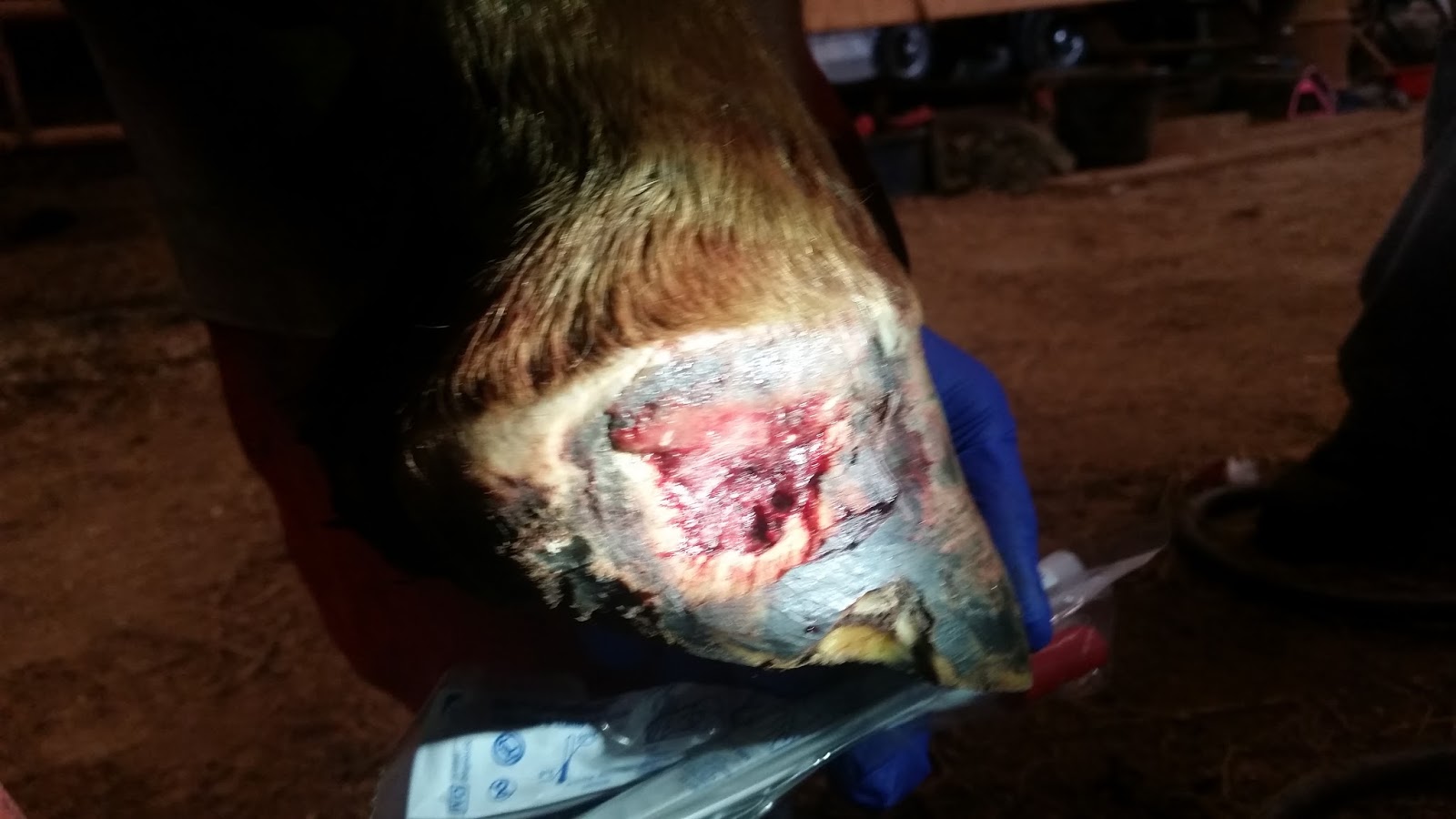
 Horse who sliced a chunk of hoof out on a fence
 Uterine prolapse post foaling
 Barn cats and chickens

 Castrating
 Foal who went through a fence

I know I'm a little late but we've been extremely busy the last few weeks at Rood and Riddle. But all the busyness has led to some great experiences! In addition to the pictures I have to share, I would like to give an overview of the things I became competent in over the summer under the careful guidance of Dr Friend. I have been able to give both IV and IM shots, draw blood, rectally palpate mares, find ovaries, find pregnancies, flush and infuse the uterus, artificially inseminate mares, sew caslicks, castrate colts, and I even got to inject some joints as well as do a few nerve blocks. I had a wonderful experience down here and can't thank Dr Friend enough for everything he taught me as well as the faith he had in me to trust me to work on some of his patients. I highly recommend this experience for anyone who wants to know what a busy ambulatory practice is like and who wants the chance to learn practical skills.



Yearling who broke her maxilla
Thanks for reading along all summer!
Sarah
Thursday, July 23, 2015
Greetings from Clinton Vet!
Hey guys!
Just wanted to give some updates on all that was going on in mid-Michigan the past couple weeks. While I am technically done with this externship, I still wanted to share some final, interesting cases.
Clinton is wonderful in that they offer so many different avenues into the world of large animal medicine. I'm sure all of the hospitals and clinics have a handful of amazing veterinarians, and Clinton has been able to show me the other half of that as well. While I know that this is for the Equine Blog, I wanted to share a little bit about the bovine world that I encountered. It's fairly standard, the farms generally like to have the same vet come out consistently, about once a week typically. They go and perform the standard herd healths; preg checks, palpations, ultrasounds, etc. However, there are always the emergency situations as well. I got to help with a DA (displaced abomasum) surgery on site. It was very clearly audible on percussion on the left side, and was a routine, common left DA. The owners did mention that they had already tried to "roll and toggle", which is basically just trying to anchor the abomasum in the correct place. However, she was still lethargic and ketotic. So Dr. Trierweiler went in on a right flank abomasopexy and attempted to deflate and reposition the abomasum. It was difficult and she could tell that she had been in this state for a while because the fat was very thin and tearing very easily. She got in the best position possible and just secured the omentum to the abdominal wall and closed her up. Based on the state of the cow however, she will most likely get culled from the herd, but we did what we could.
Another cow story, I went with Dr. Mike Trombley on an emergency calving. She had been in labor for over two hours by the time we got there, and as horse people, this might make us cringe..! I learned a lot of differences between bovine and equine delivery aspects, and there's a great deal of difference. The length of labor is drastically different, as well as the amount and frequency of dystocias. Cows are much more inclined to a dystocia because the fetus has no real restrictions in growth, and if the heifer is too small or has been bred to a large bull, this baby can be majorly disproportionate to mom! Also the angles and shapes of their pelvis leads to more complications. Another difference encountered is the retained placenta. Horses cannot stand to have it retained for more than a few hours without running into massive potential problems, yet cows can keep it for much longer, with no trouble.
A final case I wanted to mention was a yearling filly we met who had decided to try to jump a fence in between pens. She had failed miserably and ended up falling right on her chest. She immediately had massive swelling, and was far from her rambunctious self. The owners kept her on stall rest for the night, and believed she had a large hematoma. We traveled out to the farm and immediately took an X-ray. Even when we got there, she was markedly depressed and struggled to move, exhibiting some neurologic signs. She was eating and drinking normally though, which was a plus. The results, however, were not so optimistic.
 This was a lateral projection of the neck at about C3-C4. You can see that the spinous process is just completely shattered. It seems that when she landed, her chin and chest just telescoped those vertebrae into each other, causing massive trauma. Based on the intent and purpose of this horse, it was clear that it was catastrophic. Even with a miraculous surgery and recovery, she would never be able to have a good quality of life. The decision was made to put her down, unfortunately.
That was definitely not a case seen everyday, and although it was with less than ideal results, the owner was very reasonable and did what was best for the animal. At the end of the day, I guess that's all we can hope for. I am very sad to have concluded my time at Clinton Vet, but incredibly thankful for what this summer had for me and am truly grateful to all the staff there and the Fellows Program for the opportunity, I hope you all have a great rest of the summer as well! Enjoy and see you soon.
-Taylor
Just wanted to give some updates on all that was going on in mid-Michigan the past couple weeks. While I am technically done with this externship, I still wanted to share some final, interesting cases.
Clinton is wonderful in that they offer so many different avenues into the world of large animal medicine. I'm sure all of the hospitals and clinics have a handful of amazing veterinarians, and Clinton has been able to show me the other half of that as well. While I know that this is for the Equine Blog, I wanted to share a little bit about the bovine world that I encountered. It's fairly standard, the farms generally like to have the same vet come out consistently, about once a week typically. They go and perform the standard herd healths; preg checks, palpations, ultrasounds, etc. However, there are always the emergency situations as well. I got to help with a DA (displaced abomasum) surgery on site. It was very clearly audible on percussion on the left side, and was a routine, common left DA. The owners did mention that they had already tried to "roll and toggle", which is basically just trying to anchor the abomasum in the correct place. However, she was still lethargic and ketotic. So Dr. Trierweiler went in on a right flank abomasopexy and attempted to deflate and reposition the abomasum. It was difficult and she could tell that she had been in this state for a while because the fat was very thin and tearing very easily. She got in the best position possible and just secured the omentum to the abdominal wall and closed her up. Based on the state of the cow however, she will most likely get culled from the herd, but we did what we could.
Another cow story, I went with Dr. Mike Trombley on an emergency calving. She had been in labor for over two hours by the time we got there, and as horse people, this might make us cringe..! I learned a lot of differences between bovine and equine delivery aspects, and there's a great deal of difference. The length of labor is drastically different, as well as the amount and frequency of dystocias. Cows are much more inclined to a dystocia because the fetus has no real restrictions in growth, and if the heifer is too small or has been bred to a large bull, this baby can be majorly disproportionate to mom! Also the angles and shapes of their pelvis leads to more complications. Another difference encountered is the retained placenta. Horses cannot stand to have it retained for more than a few hours without running into massive potential problems, yet cows can keep it for much longer, with no trouble.
A final case I wanted to mention was a yearling filly we met who had decided to try to jump a fence in between pens. She had failed miserably and ended up falling right on her chest. She immediately had massive swelling, and was far from her rambunctious self. The owners kept her on stall rest for the night, and believed she had a large hematoma. We traveled out to the farm and immediately took an X-ray. Even when we got there, she was markedly depressed and struggled to move, exhibiting some neurologic signs. She was eating and drinking normally though, which was a plus. The results, however, were not so optimistic.

That was definitely not a case seen everyday, and although it was with less than ideal results, the owner was very reasonable and did what was best for the animal. At the end of the day, I guess that's all we can hope for. I am very sad to have concluded my time at Clinton Vet, but incredibly thankful for what this summer had for me and am truly grateful to all the staff there and the Fellows Program for the opportunity, I hope you all have a great rest of the summer as well! Enjoy and see you soon.
-Taylor
Wednesday, July 22, 2015
Weeks 9 and 10 RREH in surgery
Hello Again! Surgery has been busy preparing for the September Sales! Kentucky has been experiencing a ton of thunderstorms this summer which unfortunately means lacerations.
 The laceration pictured above was presented to RREH surgery on emergency. After taking radiographs and evaluating the edema it was confirmed that the laceration entered the joint space and there were bony chips that needed to be removed. Dr. Woodie decided to wrap the leg in a full limb bandage with an osmotic sweat to reduce the edema and then remove the chips via an arthroscopy the following day and repair the laceration.

 The next laceration was on a yearling was repaired immediately and a drain tube was placed and the leg was wrapped. The yearling was placed on antibiotics and stall rest.
 Along with lacerations there have been many foal colics. The foal pictured above was being treated in the hospital for enteritis for two weeks. The foal did not improve and therefore an abdominal exploratory was performed. Pictured above is feet of small intestine that was necrotic and infected. A culture was taken to try and discover what bacteria was causing the intestine to die. The small intestine on palpation was paper thin and would perforate easily in multiple places. The foal was 4 weeks old at the time of this surgery. Unfortunately, the damage was very severe with a guarded prognosis and a high chance of the foal being a chronic lifetime colic candidate.

Finally this foal that weighed only 150lbs was presented with severe angular limb deformities. The foal required transphyseal screws and wires to be placed correct the deformity. The screws are placed on the outside of the limbs to slow the growth of the outside so the legs will straighten and turn in.
Thanks everyone for reading!!
Jackie


Finally this foal that weighed only 150lbs was presented with severe angular limb deformities. The foal required transphyseal screws and wires to be placed correct the deformity. The screws are placed on the outside of the limbs to slow the growth of the outside so the legs will straighten and turn in.
Thanks everyone for reading!!
Jackie
Subscribe to:
Posts (Atom)